
Why Most Contractors Lose Money on Jobs They Think Are Profitable
Most contractors finish a job, get paid, and still wonder where the money went. The problem is rarely the work. It is the pricing. This guide breaks down the three hidden costs that quietly eat your profit on every job and shows you how to use a free calculator to price correctly before your next quote.
The Job That Should Have Paid Well
You finished the job on time. The client was happy. You sent the invoice, got paid, and moved on to the next one.
Then you looked at your bank account three months later and wondered where the money went.
Sound familiar? You are not alone. Underpricing is the single biggest reason construction businesses stay small, struggle to grow, and burn out their owners. Not laziness. Not lack of work. Not the economy. Underpricing.
The frustrating part is that most contractors who underprice their jobs do not know they are doing it. They price based on what they think the job costs, not what it actually costs. And there is a significant difference between the two.
This guide will walk you through exactly what you are missing, show you the numbers with a real example, and introduce a free tool that does the calculation for you.
What Most Contractors Actually Price
When a contractor sits down to quote a job, the process usually looks something like this: estimate the hours and multiply by an hourly rate, add up the materials, add a little extra for unexpected costs, then round to a number that feels competitive.
That approach captures maybe 60 to 70 percent of the real cost of doing the job. The rest is invisible. And invisible costs still come out of your pocket.
The Three Costs That Are Quietly Killing Your Margin
Labour Burden
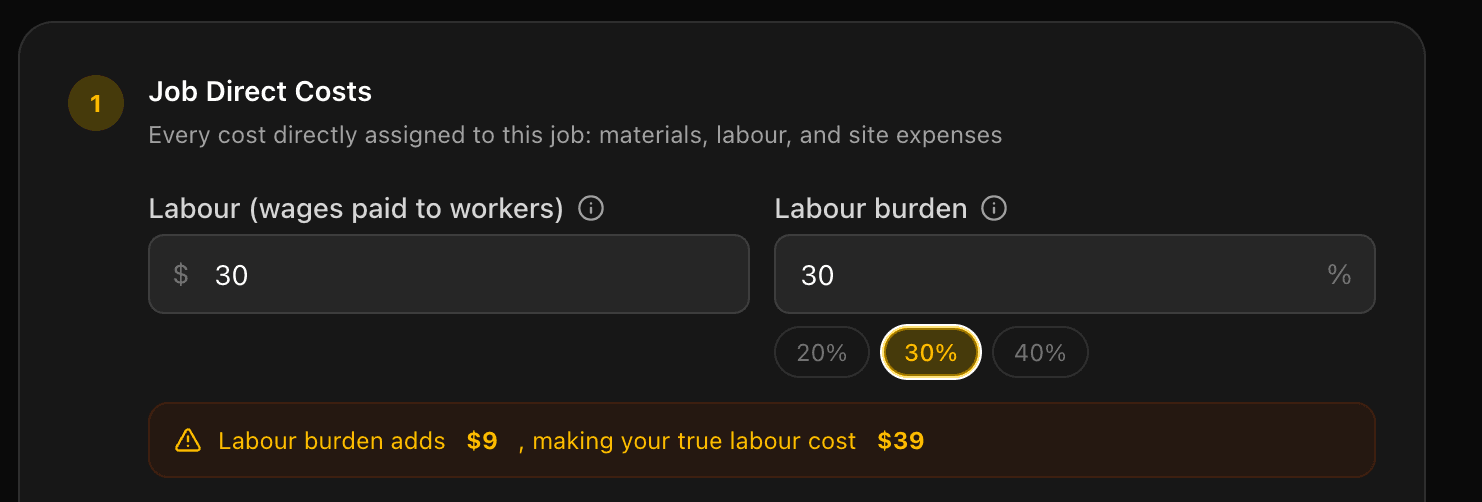
Your hourly rate for a worker is not what that worker actually costs you. On top of wages, you pay payroll taxes, workers compensation insurance, liability insurance, and in many cases benefits, paid leave, and superannuation or retirement contributions.
This additional cost is called labour burden, and it typically adds 20 to 40 percent on top of base wages.
A worker you pay $30 per hour likely costs you $38 to $42 per hour when you factor everything in. If you are quoting jobs based on the $30 number, you are already losing before the first nail goes in.
Your Overhead Share
Every job your business takes on needs to carry a portion of your business running costs. Rent, insurance, accounting, tools, vehicle repayments, phone bills, software subscriptions. These costs exist whether you are on a job or not.
If your business costs $8,000 a month to run and you are running two jobs at a time, each job needs to cover $4,000 per month just to keep the lights on. A four-week job needs to carry $4,000 in overhead before you have made a single dollar of profit.

Most contractors never include this in their quotes. They think of overhead as a business problem, separate from job pricing. It is not. It is a job cost. Every job.
Markup Versus Margin
This one trips up experienced contractors more than beginners, because the error is subtle.
A 25 percent markup on your costs is not a 25 percent profit margin on your revenue. They sound similar but they are very different numbers.
If your job costs $10,000 and you apply a 25 percent markup, you charge $12,500. Your profit is $2,500. But your margin, which is profit as a percentage of revenue, is $2,500 divided by $12,500. That works out to 20 percent.
Now imagine you have been telling yourself for years that you make 25 percent on every job. You actually make 20 percent. On a business doing $500,000 a year in revenue, that difference is $25,000 in missing profit. Every year.
What a Real Job Actually Costs: A Worked Example
Let us run through a real scenario using the free Job Pricing Calculator at BuilderView.
The job: A bathroom renovation, estimated at four weeks.
Inputs: Labour $8,000 (200 hours at $40/hr), labour burden 30%, materials and fittings $6,500, subcontractors (tiling) $2,200, monthly overhead $6,000, concurrent jobs 2, target profit margin 20%.
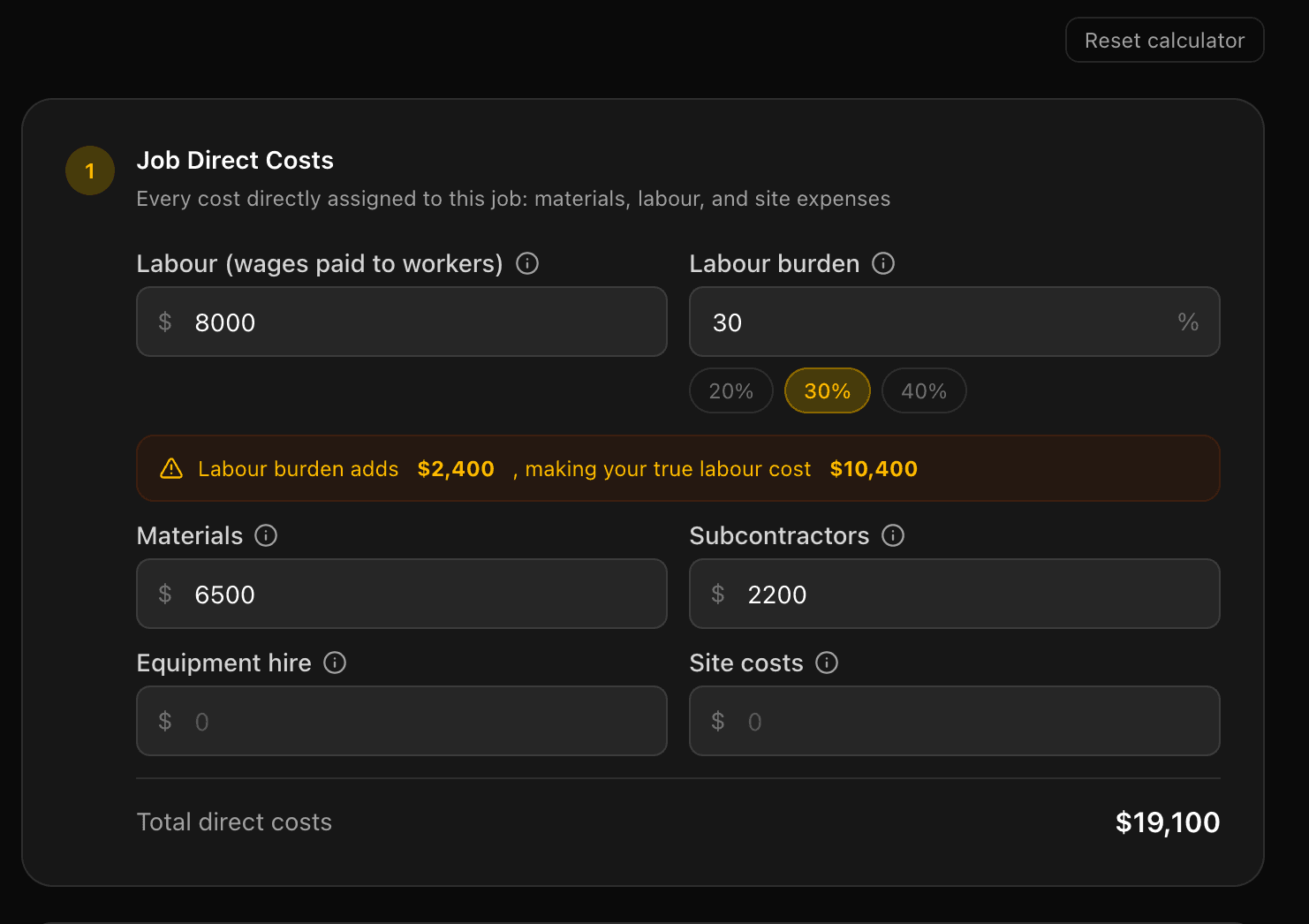
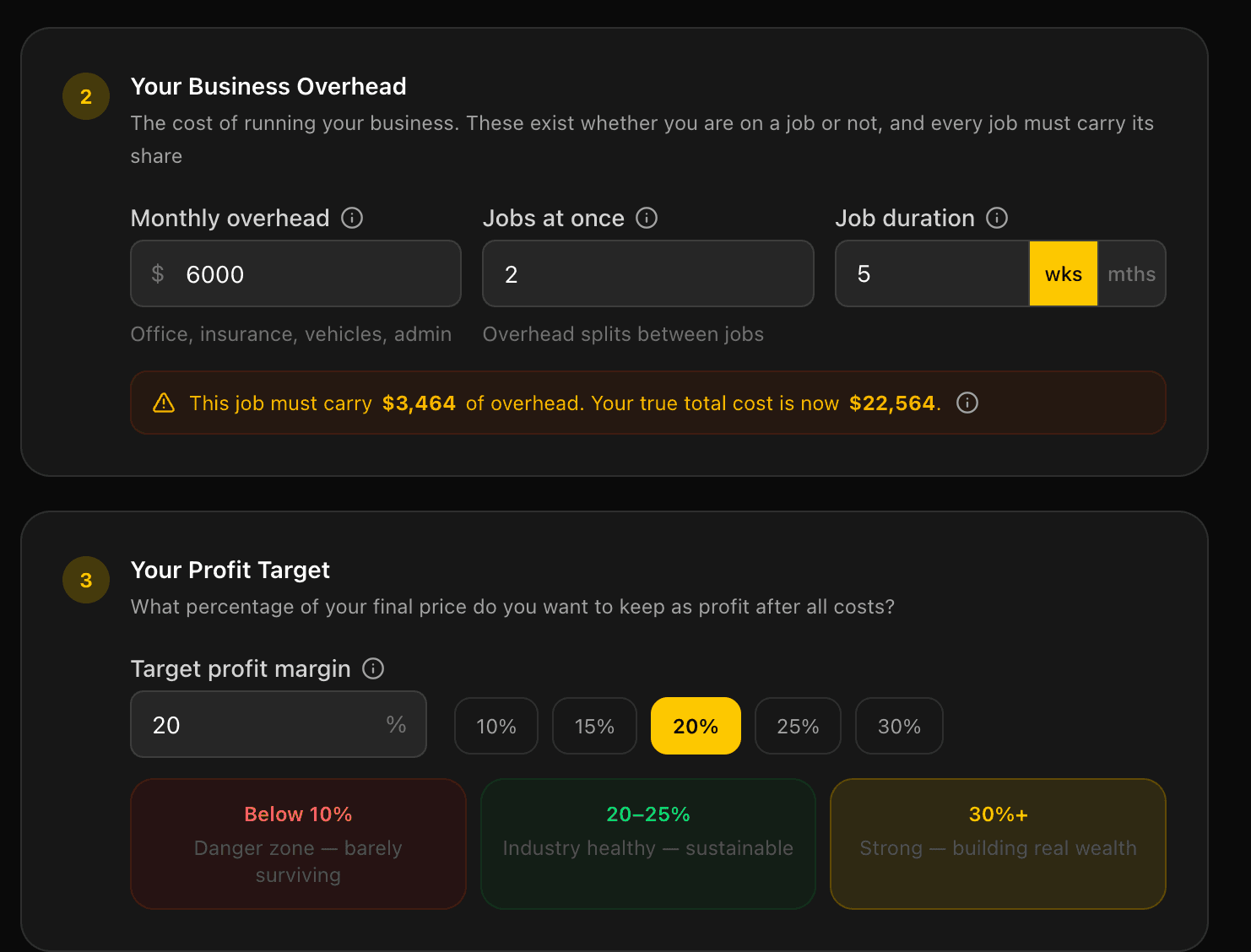
When you run this through the calculator, here is what comes back: labour with burden $10,400 (not $8,000), materials and subs $8,700, overhead share for this job $5,586 (four weeks of half your monthly overhead), true total cost $24,686, minimum price to charge at 20% margin $30,858.
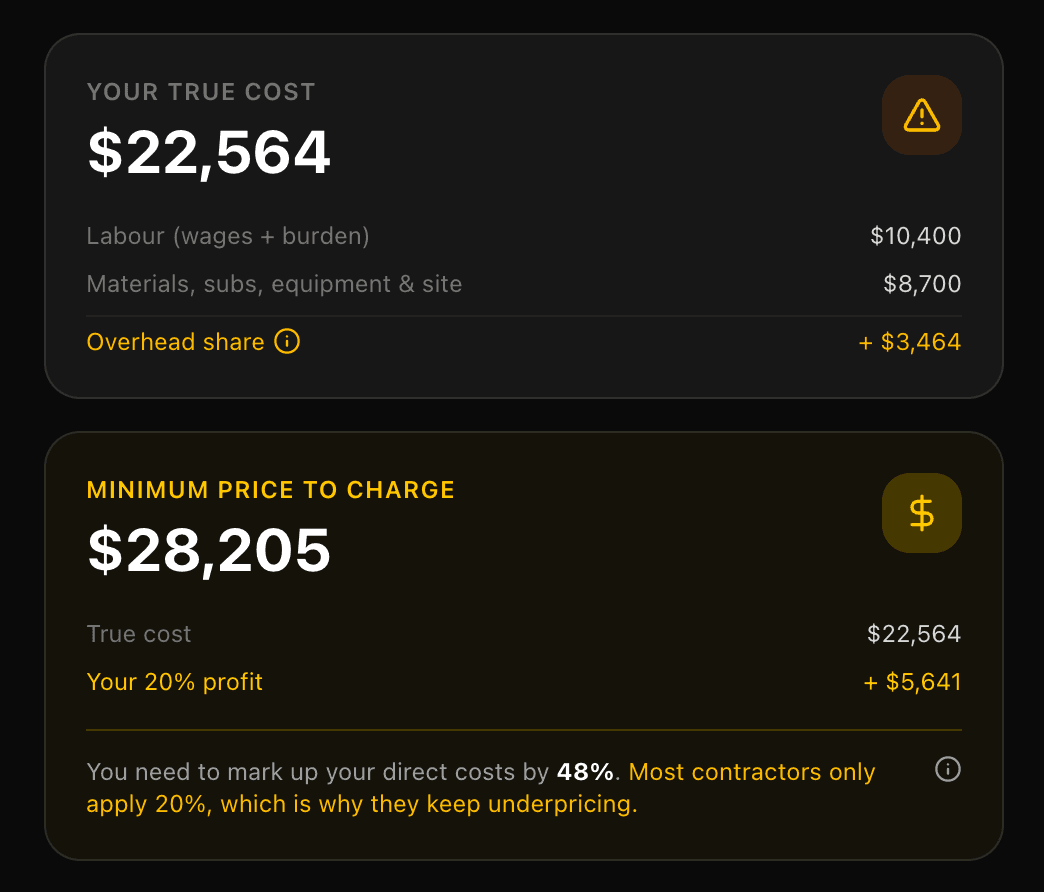
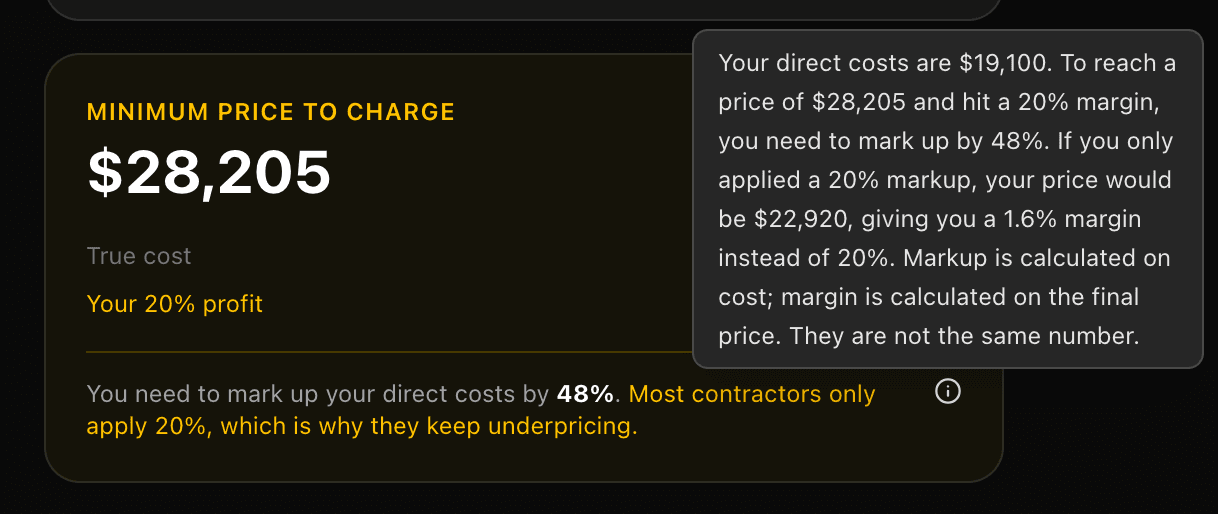
Most contractors quoting this job from gut feel would come in somewhere between $22,000 and $26,000. They would think they were making good money. They would be losing money or breaking even at best.
What Happens When You Discount
One of the most useful features of the calculator is the profit cascade table. It shows you exactly what happens to your margin when you come down on price to win a job.
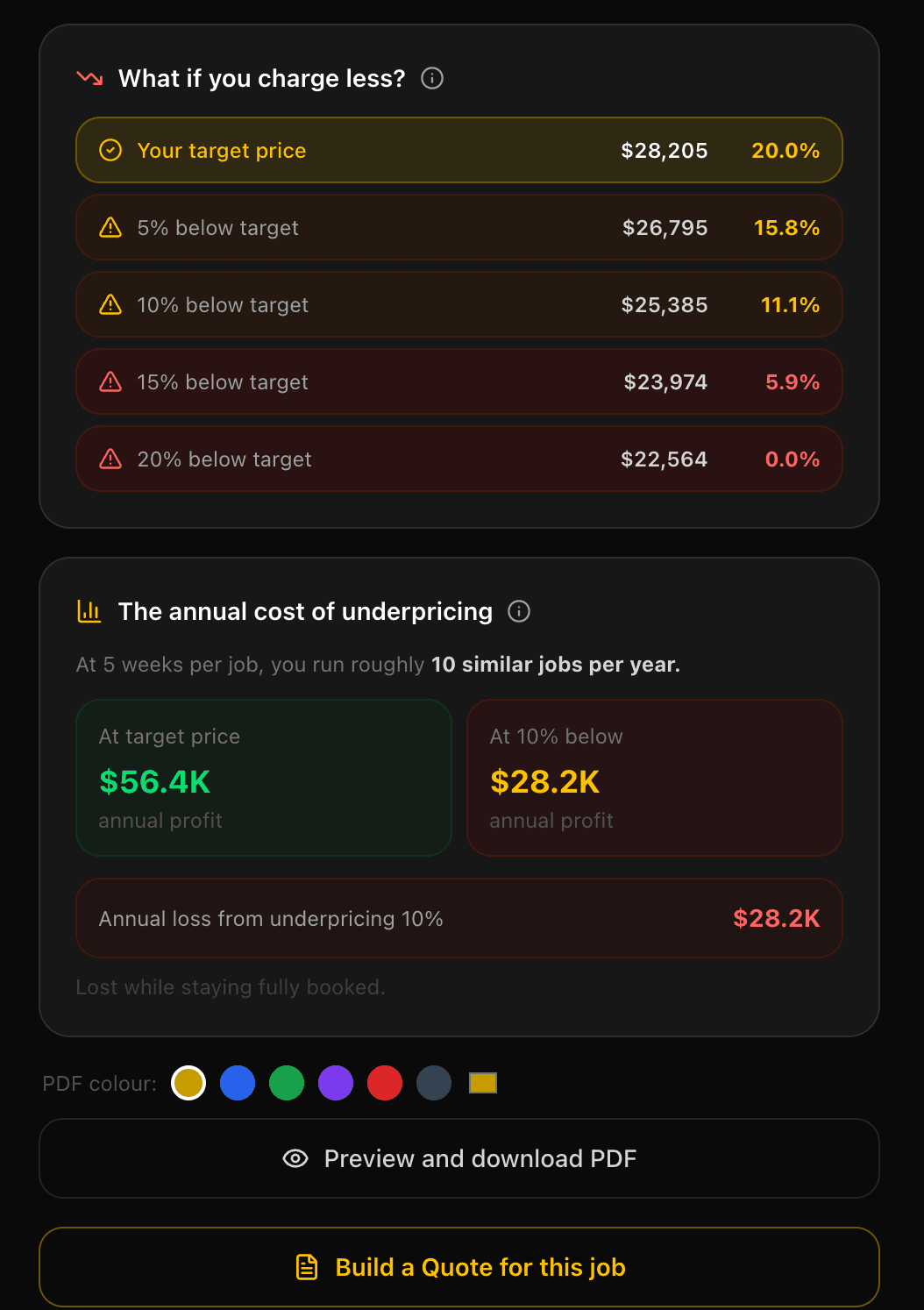
Notice how quickly a small discount destroys your margin. A 10 percent discount on a job that should have been priced at $30,858 takes you to $27,772 and drops your profit margin from 20 percent to 11 percent. That is not a small discount. That is nearly half your profit gone.
Now multiply that across every job you do in a year.
The Annual Cost of Underpricing
If you do similar jobs throughout the year, the calculator estimates how many you can complete based on job duration. For the bathroom renovation above, that is roughly 12 jobs per year.
[IMAGE: The annual impact section showing profit at target price vs 10% below, and the annual difference]
At the target price of $30,858 per job, your annual profit from labour and overhead contribution is substantial. Price every job 10 percent below that and you lose thousands of dollars per year while staying fully booked and working just as hard.
That is the real cost of underpricing. Not just one job. Every job. All year.
How to Use the Free Job Pricing Calculator
The calculator is free, takes about two minutes to fill in, and requires no account or signup.
Start by entering your direct costs for the job, including labour, materials, subcontractors, equipment, and site expenses. Then add your labour burden percentage. If you are not sure, 30 percent is a safe starting point. Enter your monthly business overhead and how many jobs you typically run at the same time. Set your target profit margin. Between 20 to 25 percent is healthy for construction. Finally, enter the expected job duration.
The calculator shows you your true cost, the minimum price you should charge, the markup required, and what happens to your margin if you discount.
You can also download the full results as a PDF to keep on file or review with a business advisor.
From Calculator to Quote
Once you know what to charge, the next step is presenting that price professionally to your client. BuilderView also offers a free Quote Builder that turns your pricing into a polished PDF quote you can send directly.
You can jump straight from the calculator to the quote builder with one click. Your recommended minimum price carries across automatically so you can see your margin in real time as you build the quote.
Stop Guessing. Start Pricing Correctly.
The difference between a contractor who struggles and one who builds a real business often comes down to one thing: knowing their numbers.
The Job Pricing Calculator does not replace experience or skill. It just makes sure the experience and skill you bring to every job is actually reflected in what you get paid for it.
Use the free Job Pricing Calculator here
If you want to track your margin automatically across every project, not just before you start but as the job runs, BuilderView does that for you. Every project, every day, in real time. No spreadsheets. No guessing. No surprises when you check the bank account.
Start your free 14-day trial at getbuilderview.com. No credit card required.